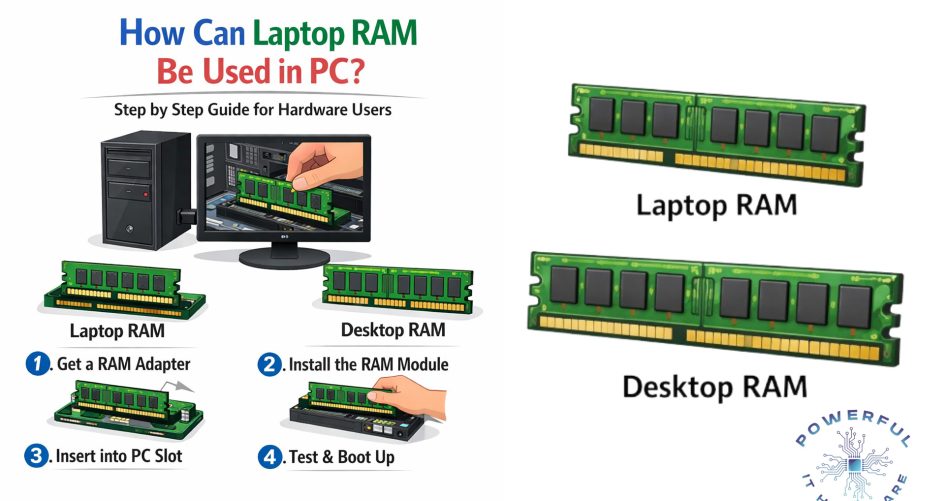
The integration of components across different form factors is a frequent topic of discussion within the hardware community, particularly for those involved in wholesale distribution and custom system building. As the line between high-performance laptops and compact desktops blurs, questions regarding component interchangeability become increasingly relevant for inventory management and technical solutions. Understanding whether can laptop ram be used in pc scenarios is technically viable helps businesses optimize their sourcing strategies and reduce obsolete stock. This analysis provides a comprehensive breakdown for hardware professionals looking to maximize the utility of their memory inventory.
1. How Can Laptop RAM Be Used in PC: Analyzing Physical and Electrical Differences
The primary obstacle preventing the direct use of laptop memory in desktop computers is the fundamental difference in physical design and electrical configuration. Laptop memory modules, known as SO-DIMMs (Small Outline Dual In-Line Memory Modules), are significantly smaller than their desktop counterparts, DIMMs (Dual In-Line Memory Modules). This size reduction is necessary to fit within the slim chassis of portable computers but renders them incompatible with the larger slots found on standard desktop motherboards. Consequently, a direct physical installation is impossible without the use of specialized, often unreliable, adapter hardware that is rarely suitable for professional or wholesale deployment.
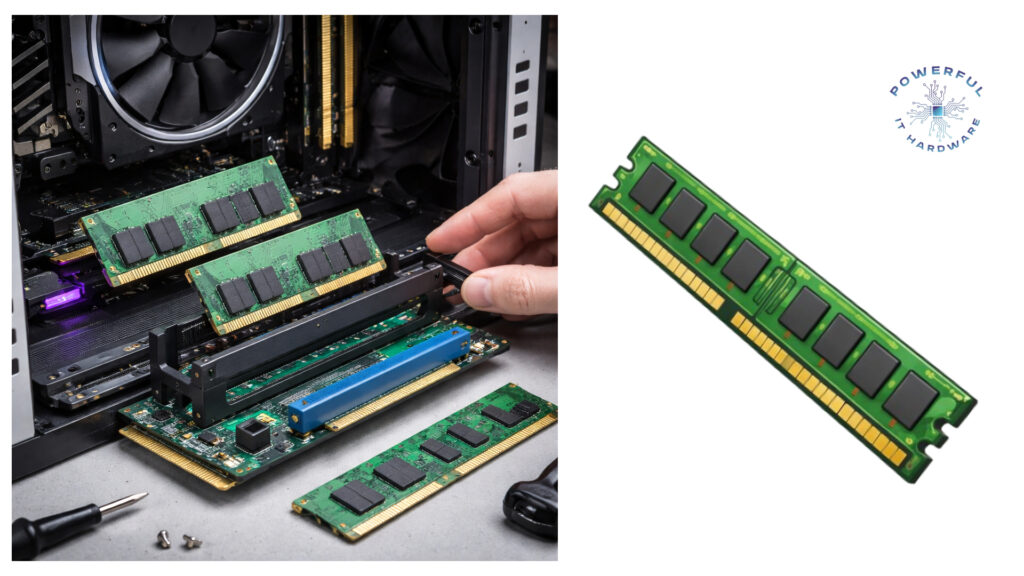
Beyond physical dimensions, the electrical specifications and signaling protocols between SO-DIMMs and DIMMs can vary, even when they share the same generation technology such as DDR4 or DDR5. While the underlying memory technology might be similar, the printed circuit board (PCB) layout and the pin configuration are designed to interact specifically with the memory controllers of their respective platforms. Desktop motherboards expect a specific pin arrangement and voltage regulation that differs from the laptop standard. Attempting to bridge this gap requires active conversion electronics that can introduce latency, instability, and potential data corruption, which are unacceptable risks for B2B clients and enterprise environments.
For hardware users managing inventory, the distinction between these form factors is critical for maintaining catalog accuracy and preventing costly returns. Wholesale suppliers must clearly differentiate between can laptop ram be used in pc queries and the reality of module compatibility to educate their customers effectively. When a business attempts to source memory for a large fleet of desktops, confusing SO-DIMM stock with DIMM requirements can lead to significant operational downtime and logistical headaches. Therefore, understanding these mechanical and electrical barriers is the first step in professional inventory management and system integration.
The market for memory modules continues to evolve, with 2025 seeing a stricter segregation of form factors to optimize performance for specific use cases. Manufacturers are designing memory that is highly tuned for the thermal constraints of laptops versus the performance headroom of desktops. This trend means that while the architecture may share a DDR designation, the operational parameters are diverging. Professionals must recognize that old computer ram from laptops serves a distinct market segment and should not be marketed as a cross-compatible solution for desktop upgrades without significant caveats regarding hardware adapters.
2. Why Do Hardware Users Attempt to Use Laptop Memory in Desktop Systems?
The curiosity regarding whether can laptop ram be used in pc often stems from economic incentives and the desire to repurpose existing hardware assets. Businesses and individual hardware users frequently find themselves with surplus SO-DIMM modules from decommissioned laptops or upgrades. Rather than letting these components go to waste, the logical question arises whether these valuable assets can be redeployed in desktop environments to save costs. This drive for cost efficiency is particularly strong in the B2B sector, where maximizing the return on investment for IT hardware is a key performance indicator for procurement departments.
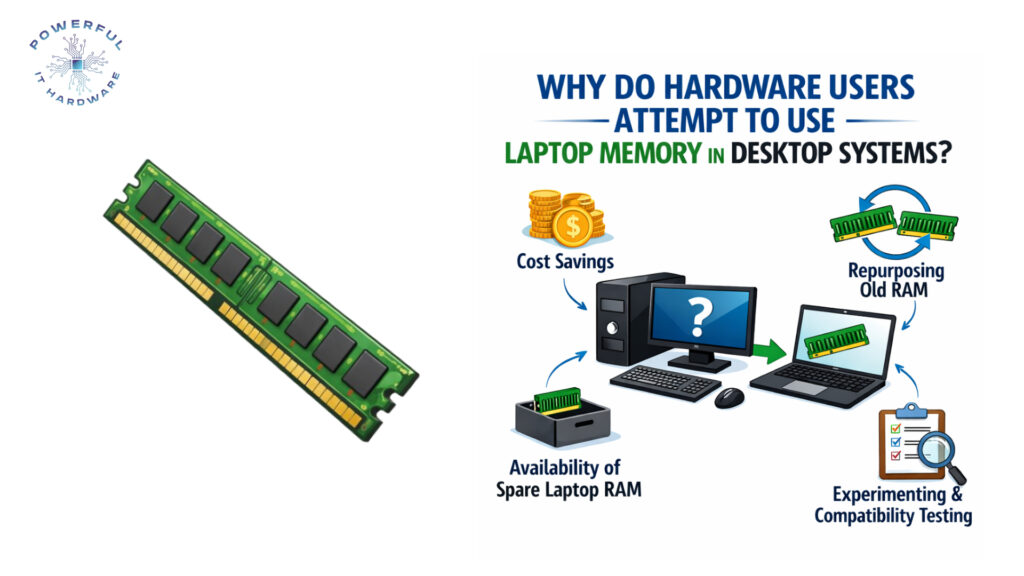
Another significant driver is the increasing power and density of laptop memory, which can sometimes match or exceed the specifications of older desktop modules. Modern high-performance laptops utilize SO-DIMMs with very high clock speeds and tight timings, making them physically capable of handling demanding data processing tasks. A hardware user looking at a stick of high-end DDR5 laptop my ram memory might see the raw potential capacity and speed, assuming it should function in a desktop setting. This perception is reinforced by the unification of memory standards, where the same generation (e.g., DDR4) is used across both platforms, obscuring the physical incompatibility.
From a wholesale and customization perspective, the push to utilize laptop memory in desktops is also driven by the compact PC market, such as Mini-ITX and Small Form Factor (SFF) builds. Some of these specialized desktop motherboards are actually designed to accept SO-DIMMs to save space on the PCB. In these specific custom scenarios, the question of compatibility shifts from “if” to “how,” as the hardware is explicitly built for this purpose. This niche allows wholesalers to market laptop memory modules to builders of compact custom rigs, creating a vital sales channel for SO-DIMM inventory that might otherwise sit idle.
However, outside of these specific Small Form Factor builds, the attempt to adapt laptop memory for standard desktops is often a result of misunderstanding component lifecycle management. As we move through 2025, industry data suggests that nearly 30% of hardware returns in the memory sector are due to form factor mismatches. This statistic highlights a knowledge gap that wholesalers must address through better technical documentation. Customers attempting to use old computer ram from laptops in standard ATX towers need clear guidance to prevent friction in the supply chain and ensure they purchase the correct DIMM modules for their specific desktop requirements.
3. Which Technical Adapters and Workarounds Exist for Memory Conversion?
While native compatibility is non-existent for standard motherboards, the market has produced various adapters that technically allow SO-DIMMs to be connected to DIMM slots. These adapters act as a physical bridge, allowing the smaller laptop module to slot into the larger desktop connector. However, these solutions are generally not recommended for professional environments or critical business infrastructure due to potential reliability issues. The electrical traces on these adapters can introduce signal interference, leading to system instability, blue screens, or data corruption under heavy load, which poses a severe risk to business continuity.
For those exploring these options, it is essential to understand that the quality of the adapter determines the viability of the setup. High-quality adapters might include buffering chips or better PCB layers to mitigate signal degradation, but they still add a point of failure to the system. In a wholesale context, selling these adapters as a solution to make can laptop ram be used in pc a reality is risky. It places the burden of technical troubleshooting on the customer and can damage the reputation of the supplier if the user experience is poor. Professional system integrators almost universally avoid these adapters in favor of native form factor memory to ensure stability.
The only legitimate scenario where laptop memory is used in a desktop-class system is with specific industrial or embedded motherboards designed for SO-DIMMs. These boards are often used in digital signage, thin clients, or specialized industrial PCs where space is at a premium. In the customization market, supplying these specific motherboards alongside SO-DIMM memory is a valid B2B strategy. It allows businesses to leverage the high availability and density of laptop memory for custom embedded solutions. This approach bypasses the need for unreliable adapters by using hardware natively designed to accept the smaller form factor.
Looking toward 2026 market insights, the industry is not moving toward greater compatibility via adapters, but rather toward more integrated memory solutions. Future platforms are increasingly utilizing soldered memory or proprietary form factors, making the adapter route even less viable. For a hardware user today, relying on adapters to repurpose my ram memory or old computer ram is a short-term fix with diminishing returns. The focus for businesses should instead be on accurate inventory forecasting and sourcing the correct DIMM modules for desktop upgrades, rather than trying to engineer incompatible hardware to fit.
4. How Does Component Incompatibility Affect Wholesale and Customization Orders?
For wholesalers, the issue of memory incompatibility is a significant factor in return rates and customer satisfaction. When customers incorrectly assume that can laptop ram be used in pc is a straightforward process, they inevitably order the wrong stock. This leads to a cycle of returns, restocking fees, and frustrated clients who need their systems up and running immediately. In the B2B wholesale environment, minimizing these logistical friction points is essential for maintaining healthy margins and long-term client relationships. Educating buyers on the distinct differences between SO-DIMM and DIMM inventories is a crucial value-added service.
Customization orders, where clients specify exact components for unique builds, are particularly vulnerable to compatibility errors. A client ordering a batch of custom PCs might request specific high-performance memory, but if there is ambiguity regarding the form factor, the entire build can be halted. If a procurement officer accidentally sources laptop memory for a desktop tower, the project timeline is immediately disrupted. Wholesale suppliers must implement rigorous verification checks during the customization order process to ensure that the memory form factor matches the motherboard specification, distinguishing clearly between laptop and desktop requirements.
The financial implications of these errors extend beyond just the cost of return shipping. There is the opportunity cost of holding onto old computer ram that cannot be utilized because it was purchased in error for desktop systems. Wholesalers often find themselves with excess SO-DIMM inventory that is difficult to move if their primary customer base is desktop integrators. Effective inventory categorization and strategic marketing of SO-DIMMs to the laptop repair and embedded system sectors are necessary to balance stock levels and prevent capital from being tied up in unsuitable components.
Furthermore, the complexity of component compatibility increases as we advance into late 2025 and early 2026. With the introduction of faster DDR5 standards and CAMM2 (Compression Attached Memory Module) form factors on the horizon, the risk of misidentification grows. Wholesale businesses must proactively update their catalogs and technical support teams to guide clients away from attempting cross-platform usage. By establishing authority on the question of can laptop ram be used in pc, suppliers position themselves as trusted advisors rather than merely parts vendors, thereby fostering greater loyalty and reducing costly order errors.
5. Why Is Precise Memory Specification Critical for B2B and Industrial Solutions?
In the realm of B2B and industrial computing, the precision of hardware specifications is paramount for ensuring system reliability and longevity. Industrial environments often subject hardware to extreme conditions, requiring memory modules that meet strict tolerance levels. Using improper memory types, or attempting to retrofit laptop memory into desktop industrial PCs via unreliable means, can lead to catastrophic system failures. For businesses relying on these systems for automation, data processing, or control systems, the stability provided by correctly specified, native DIMM modules is non-negotiable.
The customization of industrial PCs frequently involves tight thermal and power constraints, making the selection of the correct memory form factor a critical engineering decision. While a standard desktop uses DIMMs for better heat dissipation and accessibility, an industrial compact PC might utilize SO-DIMMs for space efficiency. However, these are design choices made at the factory level, not aftermarket modifications. When a business approaches a wholesaler for a custom solution, the supplier must clarify the chassis and motherboard constraints to ensure the provided memory—whether it is my ram memory for a laptop upgrade or a server-grade DIMM—is exactly what the application requires.
Recent 2025 statistics indicate that system instability due to memory mismatching accounts for a significant portion of hardware failures in non-standard enterprise environments. As businesses push for higher performance in edge computing, the tolerances for error shrink. The question of whether can laptop ram be used in pc becomes a liability in this context. Industrial clients require assurance that the components provided have been validated for their specific hardware configuration. This validation process is a key service offered by top-tier wholesale distributors, distinguishing them from generic consumer electronics retailers.
Looking ahead to 2026, market insights suggest a growing demand for “ruggedized” and specialized memory solutions tailored to specific industrial workflows. The trend is moving away from generic, interchangeable parts toward highly optimized components. This shift reinforces the need for precise specification. Businesses cannot afford to experiment with adapters or incompatible form factors when deploying critical infrastructure. Suppliers who emphasize the importance of correct memory form factor selection and discourage the mixing of laptop and desktop memory will be the preferred partners for discerning B2B clients.
6. How Can Businesses Optimize Their RAM Inventory and Sourcing Strategies?
To mitigate the confusion surrounding memory form factors, businesses must adopt a strategic approach to inventory management and sourcing. This involves segmenting stock clearly between SO-DIMM and DIMM categories and training sales teams to identify the specific needs of the customer. When a client asks about reusing components, the sales team should be equipped to explain why can laptop ram be used in pc is generally not feasible, while simultaneously offering the correct alternative solutions. This consultative sales approach reduces returns and increases customer confidence in the supplier’s expertise.
Effective inventory optimization also involves identifying target markets for specific memory types. Wholesale distributors should market their stock of laptop SO-DIMMs directly to repair shops, educational institutions with laptop fleets, and embedded system manufacturers. Simultaneously, desktop DIMMs should be positioned toward workstation integrators, gaming PC builders, and enterprise IT departments. By channeling old computer ram and new stock into the appropriate pipelines, businesses ensure that their inventory turns over efficiently, rather than sitting in warehouses waiting for a cross-use application that is technically impractical.
Customization programs offer another avenue for optimizing sourcing. Wholesalers can offer bundled deals where motherboards and RAM are sold together as a verified compatible kit. This strategy removes the burden of compatibility checking from the end-user and guarantees that the memory matches the form factor requirements of the board. For clients looking to upgrade or build new systems, these bundles provide peace of mind. It reinforces the message that while mixing form factors is problematic, purchasing a cohesive, pre-validated solution is the path to performance and stability.
Finally, staying abreast of technological trends is essential for future-proofing inventory strategies. As the market transitions toward newer standards, the value of older DDR4 or DDR3 SO-DIMMs will fluctuate. Businesses should leverage data analytics to predict when to liquidate older stocks to specific markets that still rely on legacy technology. By understanding the technical limitations and market lifecycles of memory products, wholesalers can make informed purchasing decisions. This strategic foresight ensures they remain profitable while navigating the complexities of hardware compatibility and the evolving answer to compatibility questions.
Conclusion
The technical feasibility of using laptop RAM in a PC is constrained by significant physical and electrical differences, making direct compatibility impossible for standard systems. While niche adapters and specific industrial motherboards offer limited workarounds, the professional standard demands using memory modules that natively match the motherboard’s form factor. For the B2B wholesale and customization sectors, understanding these distinctions is vital for maintaining operational efficiency, reducing returns, and providing high-quality solutions to clients. By focusing on precise inventory management and educating customers on proper component selection, businesses can avoid the pitfalls of incompatibility.
Frequently Asked Questions
1. Can laptop RAM be used in a PC directly without modifications?
No, laptop RAM cannot be used directly in a standard desktop PC due to fundamental physical differences. Laptop memory modules, known as SO-DIMMs, are designed with a smaller footprint to fit compact chassis, whereas desktops require full-sized DIMMs. The physical slot configurations and pin layouts are entirely incompatible, making a direct plug-and-play solution impossible without specialized hardware adapters.
2. Why are SO-DIMM and DIMM form factors not interchangeable?
The distinction exists to optimize hardware for specific environments and thermal management. SO-DIMMs are engineered for space-constrained laptops with lower power thermal profiles, while DIMMs are larger to accommodate better heat dissipation and stability for high-performance desktop processing. Attempting to bridge this gap ignores the electrical and mechanical design intent of the respective platforms, leading to potential hardware failures.
3. How can businesses identify the difference between laptop and desktop RAM?
Businesses can identify the difference by physically inspecting the length of the module and the notch position on the gold pins. SO-DIMMs are typically roughly 3 inches long, whereas DIMMs are about 5.25 inches long. For wholesale inventory management, relying on detailed SKU descriptions that explicitly state “SODIMM” for laptops and “DIMM” for desktops is essential to prevent costly procurement errors.
4. Are there reliable adapters available to make laptop RAM compatible with desktop motherboards?
While adapters exist on the market, they are generally considered unreliable for professional or enterprise use. These passive bridges often introduce signal integrity issues, electrical noise, and instability, which can result in data corruption or system crashes. For B2B applications where uptime is critical, relying on such adapters is discouraged in favor of using natively compatible memory modules.
5. In which specific desktop scenarios is laptop RAM actually compatible?
Laptop RAM is compatible with desktop systems specifically designed for the Small Form Factor (SFF) or Mini-ITX market. Certain industrial computers and compact desktop motherboards are manufactured with SO-DIMM slots to save space. In these specific customization scenarios, laptop memory is not only compatible but often the intended component, allowing for powerful performance in a tiny footprint.
6. How does the confusion regarding memory compatibility affect wholesale returns?
Confusion regarding whether can laptop ram be used in pc significantly impacts wholesale return rates, often accounting for a substantial portion of SKU mismatches. When customers mistakenly order SO-DIMMs for standard desktop towers, it leads to logistical friction, restocking costs, and project delays. Wholesalers must mitigate this by providing clear technical specifications and categorizing inventory to separate mobile and desktop memory solutions.
7. Can I reuse my old computer RAM from a decommissioned laptop in a new workstation?
Reusing old computer ram from a laptop in a standard desktop workstation is generally not feasible due to the form factor barrier. However, if the new workstation is a compact or custom-built unit utilizing a motherboard that supports SO-DIMMs, the memory can be successfully repurposed. Otherwise, this legacy inventory is best reserved for upgrading other laptops or dedicated embedded systems.
8. Why does my ram memory speed matter if the physical slot doesn’t match?
Even if a physical adapter could bridge the gap, the memory speed and latency timings must be supported by the motherboard’s memory controller. Mismatched speeds can lead to the system failing to boot or downgrading performance to the lowest common denominator. Ensuring compatibility involves both matching the physical form factor and verifying that the memory frequency aligns with the motherboard’s specifications.
9. How should wholesalers approach the sale of laptop RAM to desktop builders?
Wholesalers should approach this by targeting the niche market of Small Form Factor (SFF) and embedded PC builders. Marketing can laptop ram be used in pc solutions requires a focus on specialized motherboards that accept SO-DIMMs. By bundling these specific motherboards with high-performance laptop memory, wholesalers can create value-added customization kits for builders looking to create compact, powerful systems.
10. What are the future trends for memory form factors in 2025 and 2026?
Industry insights for 2025 and 2026 indicate a trend toward further specialization and integration, such as the introduction of CAMM2 (Compression Attached Memory Module) for laptops and increased soldered memory usage. This evolution suggests that the gap between laptop and desktop memory will likely widen, making cross-compatibility even rarer and emphasizing the need for precise inventory management in the wholesale sector.